History
Seed catalogues and the season
A seasonal catalogue is written against a calendar the reader already keeps. That shared timetable does most of the organising work.
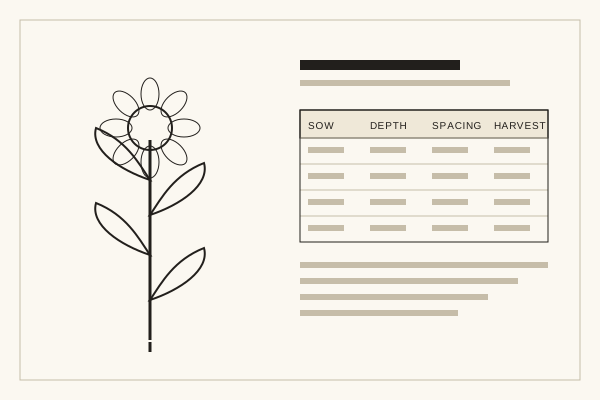
Seed catalogues are unusual among catalogues in that their readers share a timetable. Everyone using the book is working against the same seasons, and mostly in the same sequence: plan, order, sow, thin, harvest. A catalogue that follows that order needs far less explanatory scaffolding than one that has to invent a structure for its reader.
Sequence follows the year
The practical consequence is that seasonal catalogues are frequently arranged by when a thing is done rather than by what kind of thing it is. Grouping everything sown early together is more useful to a reader planning a season than grouping all root vegetables together, even though the second arrangement looks tidier in a contents list. The tidier arrangement serves the person browsing; the calendar arrangement serves the person working.
The table is the entry
Almost every seed entry reduces to a handful of numbers: when to sow, how deep, how far apart, how long until it is ready. These belong in a small fixed table, not in prose, because they are consulted at the moment of sowing, outdoors, by someone who does not want to read a paragraph. Catalogues that bury the spacing inside a descriptive sentence are harder to use in exactly the situation they were bought for.
Description does the rest
Once the numbers are tabulated, the surrounding prose is freed to do what it is actually good at: describing flavour, habit, hardiness, and how a variety differs from the obvious alternative. This is where seasonal catalogues become pleasant reading, and where the best of them are genuinely informative, because the writer is comparing varieties for a reader who will grow them rather than praising them for a reader who will not.
Lead time and the tone of the book
Because the order, the packing and the post all have to fit before the sowing window, the book has to arrive well ahead of any activity. That gap explains the anticipatory tone common to the form: it addresses a reader in the least active part of the year and asks them to plan. It also explains why the illustrations tend to show the plant in a state the reader will not see for months, which is a promise the rest of the entry has to keep.
What survives
Seed catalogues are heavily collected because they combine botanical illustration, practical instruction and a record of what varieties were available at a given time. Even stripped of any purchasing purpose, the tables remain usable, which is not something that can be said of most old commercial print.