Craft
The catalogue as an instrument for choosing
A catalogue page is not written to be read from top to bottom. It is built so that a reader can hold several things side by side and decide between them.
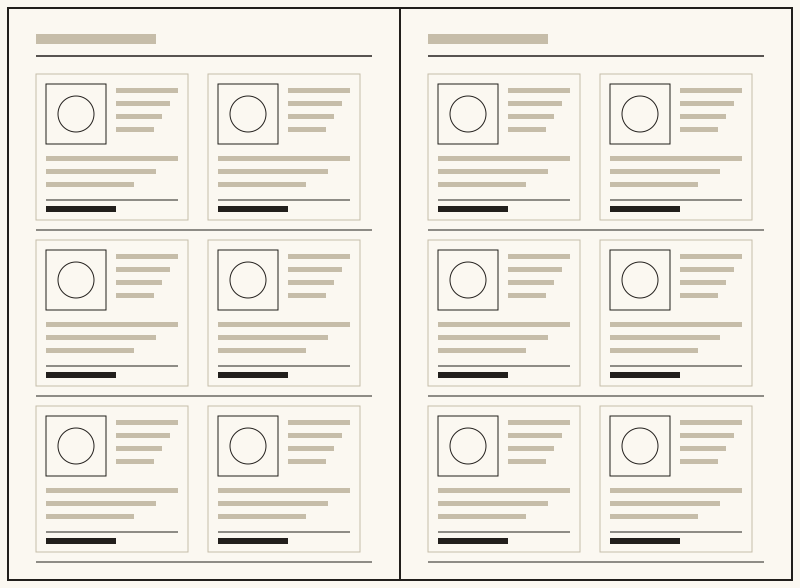
Most printed matter assumes a reader who begins at the beginning. A catalogue assumes the opposite. Its reader arrives with a question already formed, opens somewhere in the middle, and wants to compare a handful of similar things quickly enough to choose one. Everything distinctive about catalogue design follows from that single assumption.
The consequence is that the working unit of the page is not the sentence or the paragraph but the item block: a small bounded region carrying a picture, a name, a short description, and a line of specifications. The block is the thing being compared. The page is a device for putting blocks near each other.
Comparison needs alignment
If two items are to be compared, their corresponding facts must sit at the same height. A catalogue that lets one description run three lines longer than its neighbour forces the reader to hunt for the price, and hunting is exactly the cost the page exists to remove. This is why catalogue copy is written to a length rather than to an idea, and why the specification line is separated from the description instead of buried inside it.
Alignment also explains the persistence of the tabular habit in catalogues that carry many variants of one thing. Where a product exists in eight sizes, a paragraph describing all eight is nearly useless; a small table with a row per size is read in a second. The table is not a lapse into dryness. It is the correct form for a fact that varies along one axis.
Sequence carries an argument
Because the reader enters in the middle, the order of items has to do work that a narrative would otherwise do. Grouping by use rather than by name tells a reader who does not know the vocabulary where to look. Grouping by size within a use tells a reader who does. A catalogue that orders its items alphabetically has quietly decided that its reader already knows what the thing is called, which is a strong assumption and often a wrong one.
Sequence also sets expectations about scale. Placing the largest and most expensive version of a family first makes everything after it read as a reduction; placing the smallest first makes the rest read as an upgrade. Neither is dishonest, but neither is neutral, and a person planning a section should know which one they have chosen.
Density is a service, not a failing
Catalogue pages look crowded to eyes trained on modern layouts, and the crowding is deliberate. A reader comparing options wants the options on one spread. Every item pushed onto the following page is an item that will be compared badly or not at all. Generous white space, which helps a page that is read once in order, actively hurts a page that is scanned repeatedly.
The limit is legibility rather than taste. Density fails when the rules separating blocks stop being visible, when the specification line drops below comfortable reading size, or when the pictures shrink past the point where they distinguish one item from another. Those are measurable failures, and they are the ones worth arguing about.
What the form is good at
A catalogue is unusually honest about its own structure. It cannot hide a thin range behind atmosphere, because the grid shows exactly how many items there are. It cannot dodge a specification, because the empty cell is visible. Read carefully, a catalogue tells you what its maker thought was worth stating and what they hoped nobody would ask. That is why old ones remain interesting long after the goods in them have disappeared.