Ephemera
The order form as a designed object
The order form is the one page in a catalogue that the reader has to write on. Almost every feature of it exists to prevent a specific mistake.
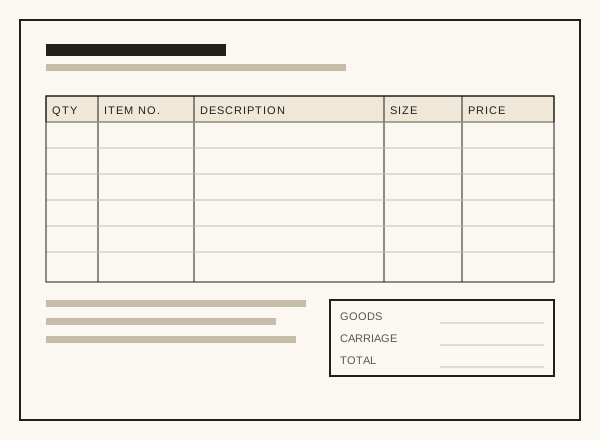
Everything else in a catalogue is read. The order form is used. That difference makes it the most tightly designed page in the book, and the one where a small failure has an immediate and countable cost: a form that invites an ambiguous entry produces a wrong parcel, a return, and a customer who does not order again.
The columns are in that order for a reason
Quantity comes first because it is the shortest field and the one most often left blank; putting it at the left edge makes an empty cell obvious. The item number follows because it is the field that actually determines what is sent. The description comes next as a check on the number rather than as a substitute for it, and the variable fields, size or colour, sit beside it because they only make sense in its company. Price and total close the row, where arithmetic naturally goes.
Designing for the pen
Handwriting needs more room than type. Boxes sized to the typeset caption above them are the classic error, and the result is cramped digits that a clerk must guess at. Ruled boxes with generous height, separated cells for digits where a number must be exact, and a printed example row are all cheap insurance. So is printing the item number in a form that cannot be confused: a number with a letter prefix survives a bad four and a worse nine.
Tolerating the predictable mistake
Well-made forms assume the reader will get something wrong and try to make the error recoverable rather than fatal. A description column that the clerk can read against the item number catches transposed digits. A field asking whether a substitute is acceptable turns a sold-out line into a decision the customer has already made. A total that the customer computes and the seller checks catches both parties' arithmetic.
Why blank forms are collected
Order forms survive in quantity because they were printed in quantity and, being loose, they escaped the fate of the catalogue itself. Collectors value the unused ones precisely because they are complete: a used form is a record of one transaction, but a blank one is a record of what the seller expected every transaction to look like. The fields it provides, and the ones it declines to provide, describe a whole way of doing business on a single sheet.
Reading a form as evidence
Anyone studying printed ephemera can learn a surprising amount from a form's small print: how orders were to be paid, what happened to a shortfall, whether carriage was included, how long delivery was expected to take. These are the operational facts that promotional pages usually leave vague, and they are stated plainly on the form because the transaction cannot proceed without them.