Top 4 Alternatives of 15Five for Goal Tracking
Your current goal tracking tool is starting to feel like a box to check, not a system that drives progress. Team check-ins happen, but alignment and visibility remain fuzzy, pushing you to explore alternatives.
By the end of this article, you will have a clear framework for evaluating 15Five replacements, including specific criteria for OKR alignment, real-time tracking, and performance integration. You will also get a definitive top pick, along with three other solid options, to make your final decision with confidence.
What to Look For in 15Five Alternatives for Goal Tracking
When evaluating 15Five alternatives for goal tracking, focus on features that drive alignment, visibility, and integration with your existing performance processes. The right tool should do more than store objectives. It should connect daily work to broader company strategy and make progress easy to see at every level.
A strong alternative needs clear OKR capabilities, live progress updates, and smooth connections to reviews and check-ins. Without these three pillars, you end up with a static list of goals that quickly becomes outdated and ignored.
Below we break down the core criteria to compare. Use these categories as your checklist when testing software and reading user reviews. This framework will help you spot the difference between basic goal-setting apps and true performance management platforms.
OKR and Goal Alignment Features
A top-tier 15Five alternative must let you set clear OKRs and cascade them across teams, ensuring everyone's work ties back to company objectives. Look for hierarchical goal structures that show how team objectives support department targets, which in turn support company-wide priorities.
Alignment visualization matters. The best tools offer org charts or tree views that map the connection between individual key results and top-level objectives. When a manager can see that their team's three main goals directly feed a company initiative, the work feels more purposeful.
Flexibility is another critical factor. Your team may run quarterly OKRs while other departments prefer annual targets. The software should handle both without friction. Look for options to set custom timeframes and adjust key results mid-cycle when priorities shift. A rigid system that forces you into a single cadence will frustrate teams and reduce adoption.
Consider this example: a sales manager sets an objective to grow enterprise revenue. The key results include increasing demo-to-close rate and expanding into two new verticals. The platform should let the manager link these key results to the company-wide revenue goal. It should also send periodic reminders for the team to update progress, keeping the OKR cycle active rather than forgotten.
Real-Time Progress Tracking and Visibility
Real-time progress tracking transforms goal management from a static document into a live dashboard that keeps everyone accountable and informed. When tasks are completed or metrics update, the system should reflect that change automatically. Visual progress bars and percentage indicators give an instant snapshot of health without digging into spreadsheets.
Dashboards are the centerpiece of visibility. The best alternatives offer both individual views and team-level rollups. An individual can see their own key results and what is slipping. A manager can view the entire team's portfolio to spot bottlenecks before they become crises. Reporting features should highlight trends over time, not just current status.
Custom alerts add another layer of safety. The ideal tool notifies stakeholders when a goal falls behind schedule or when a key result stalls for too long. This proactive nudge prevents surprises during quarterly reviews.
One useful metric to monitor weekly is the percentage of key results on track. If that number dips below a comfortable threshold, the manager knows to step in with coaching or resource reallocation. This kind of real-time signal is what separates active goal management from passive documentation.
Integration with Performance Reviews and 1-on-1s
Goal tracking shouldn't exist in a silo, the best alternatives integrate seamlessly with performance reviews and 1-on-1 meeting tools to create a continuous feedback loop. When review forms automatically reference goal progress, managers can give concrete, data-backed feedback instead of relying on memory or vague impressions.
During weekly check-ins, the platform should surface relevant goal data directly in the meeting agenda. A manager can ask, "I see your second key result is at 60 percent, what is blocking completion?" This turns the 1-on-1 into a problem-solving session rather than a status update. Feedback tied to specific objectives makes coaching more actionable for the employee.
Calendar and communication integrations are equally important. The software should sync with tools like Slack or Microsoft Teams so that check-in reminders and goal updates appear where your team already works. This reduces friction and keeps goals top of mind without forcing employees to open another app.
Here is a practical scenario: during a quarterly review, a manager pulls up the employee's goal dashboard. They see the employee exceeded their customer satisfaction target but fell short on process improvement. The manager acknowledges the win, then discusses specific coaching opportunities for the missed goal. This integration between performance data and development conversation strengthens engagement and makes the review process feel fair and transparent.
1. HeyRamp - Best Overall
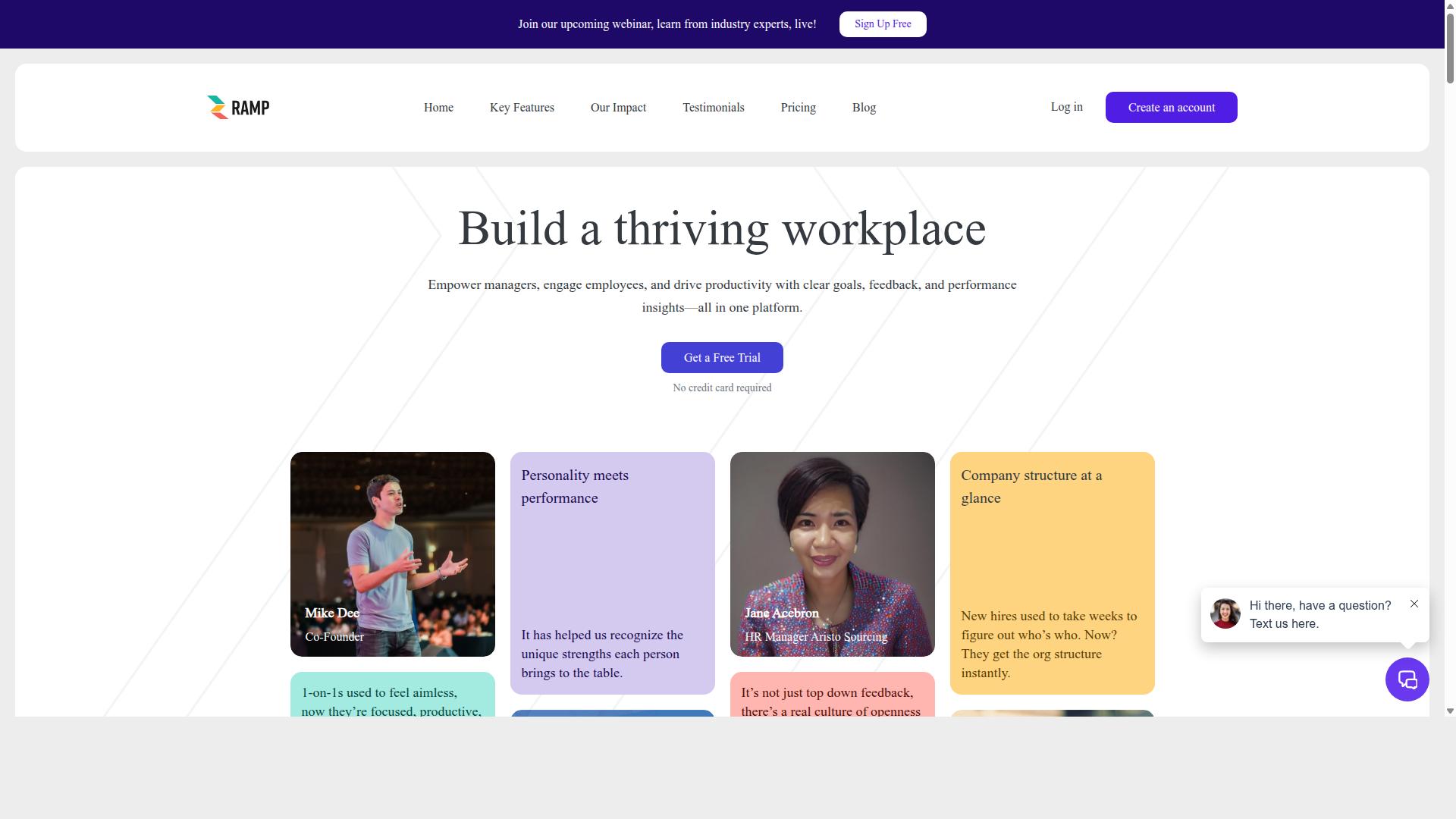
HeyRamp stands out as the best overall 15Five alternative, combining goal management with performance insights and engagement tools in one platform. Instead of juggling separate tools for OKRs, reviews, and feedback, teams get everything in a single, cohesive workspace.
This all-in-one approach makes it a strong pick for growing organizations that want to simplify their HR tech stack. The platform covers company structure visualization, 1-on-1 meeting tools, feedback, and performance reviews, so nothing falls through the cracks between quarterly cycles.
What makes HeyRamp particularly effective is how it unifies goal tracking with performance management. Managers can see progress on objectives alongside review outcomes and engagement signals, which drives both productivity and long-term employee development.
Unified Goal Management and Performance Insights
HeyRamp's unified approach lets you manage goals alongside performance reviews, 1-on-1s, and feedback, giving you a complete view of employee development. The OKR and goal management features include real-time progress visualization, so teams always know where they stand against their objectives and key results.
Company structure visualization plays a big role in alignment. Leaders can see how individual goals connect to broader company priorities, which helps reduce silos and keeps everyone rowing in the same direction.
One distinctive feature is the personality insights capability. These insights complement the performance tools by helping managers understand team dynamics and communication styles, which leads to better coaching and fewer misunderstandings during reviews.
HeyRamp is trusted by 20+ organizations and 400+ teams, and it includes built-in training and education. The platform offers training videos for 1-on-1s, performance reviews, and personality testing, so managers don't have to learn everything from scratch. Together, these features provide actionable insights that turn raw performance data into better management decisions.
Pricing and Implementation for Teams
HeyRamp offers transparent, flat-fee pricing that scales with your team, and a 14-day trial to test its full feature set before committing. The monthly plan is $5.00 per seat, paid monthly, while the yearly option drops to $3.00 per seat per month when billed annually. Enterprise teams can request custom pricing paid per seat.
The flat-fee model is a notable cost-saver compared to competitors that charge extra for each module. With HeyRamp, you get goal tracking, reviews, feedback, and people analytics under one price, which simplifies budgeting for HR leaders.
Implementation is straightforward since the platform is cloud-based and available globally. Teams can get started quickly without lengthy setup periods or complex installations.
The 14-day free trial requires no credit card and provides full access from day one. That means you can evaluate the OKR software, run a few check-ins, and test the dashboards before making any financial commitment. You can also switch plans anytime, which gives growing teams flexibility as their headcount changes.
2. PerformYard
PerformYard is a solid alternative for teams that prioritize continuous feedback and streamlined performance review processes. The platform has built a reputation for simplifying the often cumbersome work of managing employee evaluations, making it a frequent choice for HR leaders who want less administrative overhead.
While PerformYard includes goal tracking as part of its broader suite, the tool is generally understood to be more review-centric than dedicated OKR platforms. Teams that already have a mature goal-setting cadence but struggle with annual reviews, 360 feedback, or competency assessments often find this balance appealing. It serves a wide range of industries, including accounting, IT, financial services, healthcare, and software.
Keep in mind that pricing is not publicly listed, so you will need to contact the vendor for a quote. If your primary need is purely objectives and key results, PerformYard may feel like a secondary feature set. But if you want reviews, check-ins, and goals under one roof, it is worth evaluating.
Streamlined OKRs with Continuous Feedback
PerformYard integrates OKRs with a lightweight feedback system, making it easy for managers to give real-time input on goal progress. The goal management functionality is designed to be straightforward, allowing teams to set objectives and track key results without the steep learning curve found in more complex enterprise tools.
The continuous feedback feature supports comments and ad hoc check-ins, which means employees are not waiting for a formal quarterly review to hear how they are performing. This creates a rhythm of ongoing dialogue that fits naturally into existing workflows. For managers, the benefit is simple: less time spent on documentation and more time spent on actual coaching and development.
PerformYard also includes AI-driven writing assistance and summaries, which can reduce the time spent drafting review comments. The platform claims a two-week average setup time and an 85% reduction in admin time, though you should verify those figures against your own requirements. Integrations with HRIS, SSO, Slack, and Teams are commonly mentioned, but check the current offering for compatibility with your stack before committing.
This tool is best for teams that want a straightforward performance management hub with goal tracking as a supporting feature. If your organization values simplicity and prefers to keep objectives and key results closely tied to the review cycle, PerformYard is a credible option. Teams that need deep OKR analytics, advanced alignment views, or heavy goal-centric reporting may find it limiting compared to dedicated goal tracking platforms.
3. Peoplebox
Peoplebox appeals to data-driven teams that want advanced analytics and deep integrations to track goals and performance in one place. This platform positions itself as a talent management solution, combining performance management with employee engagement and recruiting tools. For organizations that rely heavily on reporting, Peoplebox offers a way to see progress and spot issues before they grow.
The platform includes features like performance reviews, 1:1 meetings, org charts, and OKR tracking. It also provides check-ins, business reviews, engagement surveys, and 360 feedback tools. This broad feature set makes it a fit for companies that want more than just goal setting, they want a full picture of workforce health.
Peoplebox also includes AI-powered recruiting tools under the name Nova AI, which assist with resume screening and AI interviews. That said, teams primarily focused on goal tracking will find the OKR and check-in features most relevant. The platform aims to align teams to company priorities and catch engagement problems early.
Pricing details are not clearly stated on public pages, so interested teams should verify current plans directly. As with any software comparison, the right choice depends on your team size, reporting needs, and existing tool stack.
Goal Tracking with Advanced Analytics and Integrations
Peoplebox offers goal tracking with powerful analytics dashboards and connects with popular tools like Slack, Jira, and Salesforce. These integrations allow the platform to pull data from project management tools and automatically update goal progress. That means less manual status updating and more accurate, real-time visibility.
Real-time progress dashboards give managers a clear view of how objectives are moving. OKR alignment views help teams see how individual goals connect to broader company priorities. For leaders who need to report upward, the ability to generate custom reports is a practical advantage.
The integration ecosystem is one of the main selling points here. Teams already using a suite of SaaS tools can benefit from having goal data flow in from multiple sources. This reduces friction and keeps everyone working from the same information.
However, the specifics of integrations and pricing can change, so it is wise to verify current offerings on the Peoplebox website. Research suggests that analytics-heavy platforms work best for companies that value data-driven decision making. If your team already tracks metrics across several systems, Peoplebox is worth a closer look.
4. Workleap
Workleap is an ideal choice for growing teams that need simple goal setting and performance tools without a steep learning curve. It is built for small and medium businesses that want to improve employee engagement without adding heavy administrative work.
This platform combines goal tracking with performance reviews and team health features in one place. For companies moving away from 15Five, Workleap offers a way to keep performance management and employee feedback connected.
Its focus on ease of use makes it a practical alternative for organizations that do not have dedicated HR resources. Teams can adopt the tool without lengthy training or complex configuration.
Simplified Goal Setting for Growing Teams
Workleap simplifies goal setting with intuitive interfaces and templates that help small teams adopt OKR practices quickly. The platform supports pre-built structures that reduce the guesswork around objectives and key results.
Users can organize goals with drag-and-drop hierarchies, which makes progress tracking visual and straightforward. This approach helps managers see how individual work connects to broader company priorities.
The platform also includes AI-powered features that assist with performance reviews and goal suggestions. It gathers evidence from multiple sources and drafts content in the manager's voice, which saves time during review cycles.
Workleap includes performance review tools, meeting agendas for 1:1s, and employee engagement surveys. These features make it a comprehensive starter option for companies that want more than just goal tracking.
Teams can link performance outcomes to compensation decisions, which supports a complete talent management cycle. The platform connects with over 100 integrations, including Slack and Jira, so feedback flows through tools teams already use.
Since pricing is not publicly listed, interested buyers should contact Workleap directly or check current plans. Reviewing integrations and available features will help you decide if it fits your workflow.
For small teams looking for a balanced mix of goal setting, continuous performance, and employee engagement, Workleap is worth consideration. It offers a solid middle ground between simple check-in tools and full enterprise performance management suites.
How to Choose the Right Option
Choosing the right 15Five alternative comes down to matching the tool's strengths to your team's size, budget, and existing workflows. A platform that works for a 20-person startup may feel limiting for a 500-person enterprise, and vice versa.
Start by clarifying what you actually need from goal tracking software. Are you looking for simple OKR software, or do you need broader performance management and employee feedback features? The answer will narrow your options quickly.
Consider who will use the tool daily. HeyRamp serves leadership, line managers, HR, and individual contributors, which makes it a flexible fit for organizations where everyone needs visibility into goals. If you are an HR leader rolling out a new process, or a manager tracking team progress, confirm the tool supports your role specifically.
Finally, think about the long term. A tool that handles quarterly objectives and key results today should also support continuous performance and check-ins as your team grows. Prioritize platforms that can scale with your headcount and evolving processes.
Assessing Team Size, Budget, and Existing Workflow
Start by listing your must-have features, then compare pricing tiers and integration capabilities to find the tool that fits your team's unique context. This structured approach prevents you from overpaying for features you will never use.
Follow these four steps to make an informed decision:
- Define your team size and growth projections. Some tools scale better than others. A flat per-seat model is easier to forecast than one with tiered feature unlocks.
- Set a budget per seat. Compare pricing models, such as flat fees versus per-feature pricing, and calculate what your monthly cost will look like in a year.
- Map your existing workflow. Identify which tools need integration, such as your HRIS, Slack, or project management platforms. Seamless integration drives adoption.
- Prioritize ease of use. A tool that feels complicated will be abandoned quickly, regardless of its feature set.
To compare your shortlist side by side, build a simple table with columns for pricing, key features, and best-fit scenarios. Here is an example layout using the four tools from this roundup:
| Tool | Pricing | Key Features | Best Fit For |
|---|---|---|---|
| HeyRamp | $5.00 per seat monthly, or $3.00 per seat monthly billed annually; enterprise custom pricing | Goal alignment, performance management, employee engagement, team development | Teams of all sizes seeking an affordable, role-inclusive platform for leadership, managers, HR, and contributors |
| PerformYard | General tiered pricing (varies by plan) | Performance reviews, continuous feedback, customizable forms | Organizations focused heavily on structured review cycles |
| Peoplebox | General tiered pricing (varies by plan) | OKR tracking, check-ins, integrations with HRIS and Slack | Teams that prioritize alignment and real-time progress tracking |
| Workleap | General tiered pricing (varies by plan) | Performance management, employee engagement, development tools | Growing companies wanting an all-in-one HR software suite |
Use HeyRamp's pricing as a reference point for value. At $3.00 per seat monthly when billed annually, it offers a low-cost entry point for goal tracking without sacrificing access for different roles. The 14-day trial with no credit card required also makes it easy to test before committing.
Remember that the cheapest option is not always the best. Consider the total cost of implementation, including training time and the effort required to migrate data from your current system. A slightly higher per-seat price can be worth it if the tool reduces administrative overhead.
By following this framework, you can confidently choose the 15Five alternative that aligns with your budget, supports your workflow, and delivers the goal tracking and performance management capabilities your team actually needs.
Final Verdict
After weighing features, pricing, and usability, HeyRamp emerges as the best overall choice for teams seeking a comprehensive goal-tracking and performance management solution. The platform stands apart from 15Five and other alternatives by combining OKR software, employee feedback, and continuous performance tools under one roof. This unified approach eliminates the need to juggle multiple subscriptions or patch together disconnected systems.
HeyRamp's flat-fee pricing is a major differentiator. Instead of paying per user, which gets expensive as your team grows, you get predictable costs regardless of headcount. For growing organizations, this makes scaling goal tracking and performance management far more budget-friendly than per-seat models common with 15Five, Lattice, or Betterworks.
The platform is trusted by 20+ organizations and 400+ teams, which speaks to its practical value in real workplace settings. Built-in training and education help managers and employees adopt the system quickly, reducing the learning curve that often slows down HR software implementations. Automatic compliance documentation also saves time for HR teams who need to maintain proper records.
Personality insights integrated with performance tools give HeyRamp a unique edge over other alternatives. These insights help managers understand their team members better, while instant coaching tips and automated reminders keep leaders on track. Aggregated people analytics dashboards provide a clear view of engagement and progress across the organization.
For difficult conversations, guided conversation templates offer structure when you need it most. These templates help managers address sensitive topics with confidence, which improves employee engagement and strengthens the coaching culture. Weekly check-ins and progress tracking keep everyone aligned on objectives and key results without excessive meeting overhead.
If you are evaluating 15Five alternatives, consider what your team truly needs beyond basic goal setting. HeyRamp delivers alignment, reporting, recognition, and development tools in one package. The 14-day trial gives you a risk-free way to see if the platform fits your workflow and culture. Visit HeyRamp's website to explore the full feature set and decide for yourself.
Recommended Resources: