How to Choose the Best BPM Software for Task Tracking: 2026 Buyer's Guide
Your task tracking breaks down when no one can prove who approved what. Missed handoffs, scattered checklists, and missing audit trails turn a simple process into a compliance risk.
This buyer's guide shows you how to evaluate BPM software for task tracking in 2026, from workflow automation and task visibility to audit-ready proof, security certifications, and data residency. You will also see where Process Street fits, what its Docs, Ops, and Cora products do together, and which plan suits your team.
What Is Process Street and Why It Defines BPM Software for Task Tracking
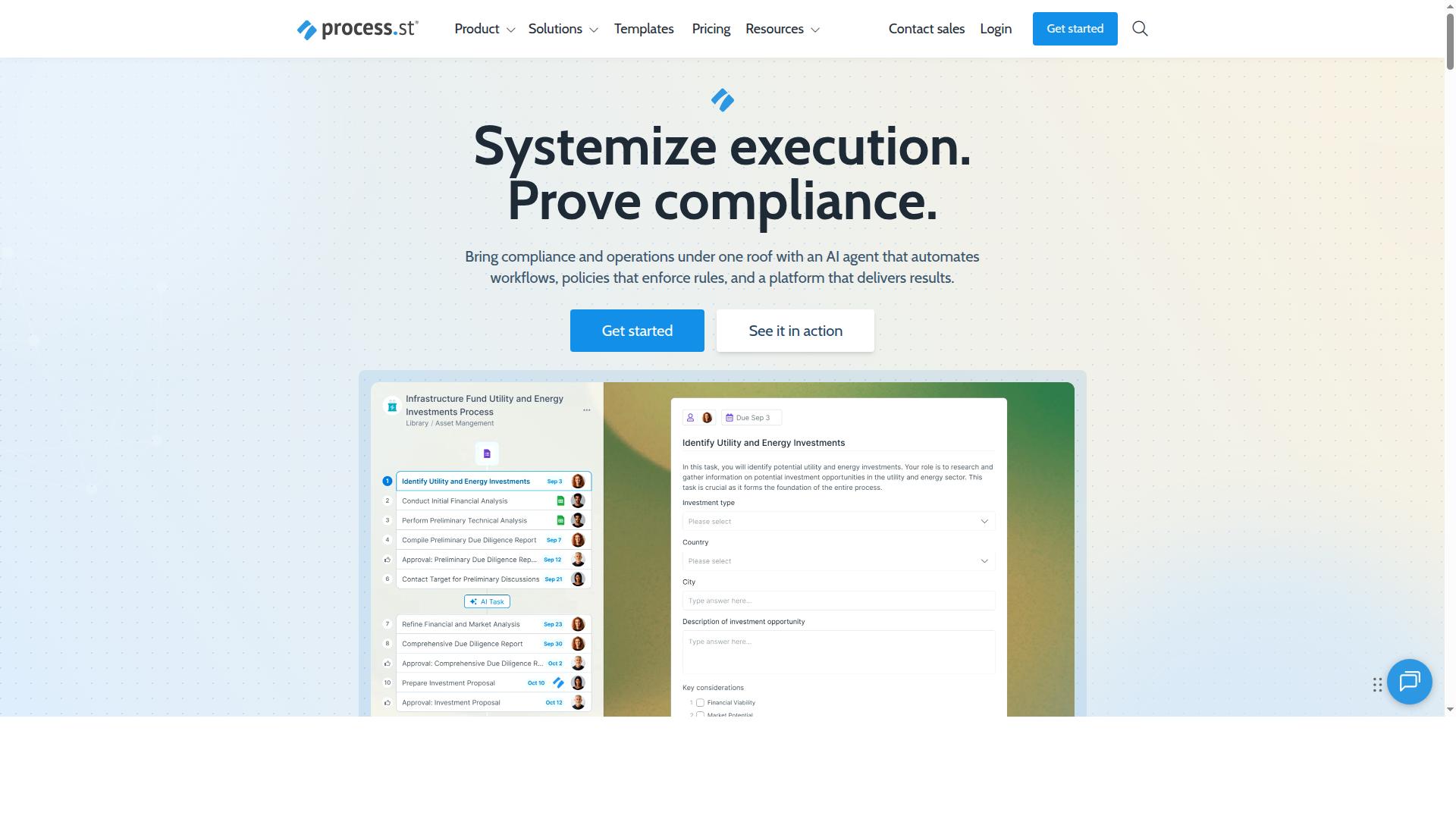
Process Street is a compliance operations platform that automates business processes, enforces policies, and delivers audit-ready proof, positioning it as a defining force in BPM software for task tracking. It gives teams one place to run recurring work the same way every time, with a visible record of who did what and when.
Most task management tools stop at assigning and closing items. Process Street connects that task tracking to workflow automation and compliance, so the work itself follows a defined path rather than relying on memory or scattered checklists.
The platform is organized around three main products:
- Docs for document management and policy control
- Ops for workflow automation and process orchestration
- Cora, an AI compliance and risk agent
That combination matters for anyone evaluating BPM software in a 2026 buyer's guide. A tool that only tracks tasks leaves a gap between what a policy says and what a team actually does. Process Street closes that gap by turning policies into actionable workflows backed by audit trails.
The core value proposition is straightforward: standardize processes, prove compliance, and maintain operational consistency. For buyers comparing platforms, that framing shifts the question from "can this tool hold my to-do list?" to "can this tool show that the work was done correctly?"
Who Process Street Serves: Teams, Industries, and Use Cases
Process Street is built for teams in operations, customer management, compliance, human resources, finance, and IT & security across industries such as financial services, real estate, manufacturing, healthcare, professional services, and technology. The platform also serves capital markets and property management, where repeatable process and documentation carry real weight.
Different roles approach the platform for different reasons. Operations managers use it to standardize how recurring work gets done. Compliance officers rely on the audit-ready proof that comes from running work through defined workflows. HR and finance teams apply it to processes that need a consistent sequence every time.
Common use cases include:
- Employee onboarding, so every new hire follows the same steps
- Client onboarding, keeping handoffs consistent across accounts
- ISO compliance, with documentation tied to the work itself
- Quality tracking and document control
- Custom workflows for team-specific processes
These examples share a pattern. They are recurring, they involve multiple people, and they need a record. That is exactly where task tracking alone falls short and where a workflow engine with process orchestration adds value.
For a buyer building a shortlist, the practical test is simple. Map your most repeated, most audited process against these use cases. If it looks familiar, Process Street is worth a serious look in your evaluation.
Is Process Street the Best BPM Software for Task Tracking in 2026?
Determining whether Process Street is the best BPM software for task tracking in 2026 requires evaluating its unique strengths against the evolving needs of modern teams. The short answer is yes, particularly for organizations where structured, repeatable work must be tracked with a clear record of who did what and when.
Process Street is a business process management platform built around a no-code workflow builder. Teams design workflows visually, assign tasks, and track progress without writing code or waiting on developer resources. That places it firmly in the low-code platform category, but with a sharper focus than most general BPM suites.
Its track record supports the claim. The platform is trusted by 3,000+ companies and 1m+ users, and 49k+ employees have used it to standardize onboarding. Those numbers reflect adoption across real operational teams, not just pilot programs.
Three differentiators stand out when judging fit for task tracking in 2026: the no-code workflow builder, audit-ready proof of work, and integration capabilities. Each one maps directly to what buyers in this guide should be evaluating.
The no-code workflow builder lets operations, HR, finance, and compliance teams create workflow templates with task assignment, task routing, approval workflows, and conditional logic. Because the drag-and-drop designer removes the need for technical skills, process owners can build and adjust workflows themselves. One customer, IMCD UK, reported a 75%+ reduction in setup time.
Speed of change matters in a workflow engine. When regulations shift or a process breaks, teams need to edit the workflow immediately rather than file a ticket. A no-code approach keeps that control with the people who own the process.
Audit-ready proof is where Process Street separates itself from general BPM software. Every task completion leaves a verifiable record, which supports compliance, governance, and internal audits. For teams managing approval workflows or regulated procedures, that audit trail is not a nice extra. It is the reason they choose a dedicated tool.
The platform's own security posture reinforces this. Process Street is SOC 2 Type II certified and ISO 27001 certified, and it is HIPAA compliant with a BAA available upon request. It is also GDPR, CCPA, and AWS CIS compliant, and customer data is never used to train AI models. Buyers who weight compliance heavily should treat these certifications as a baseline requirement in 2026.
Integration capabilities round out the picture. Process Street connects with the tools teams already use, so task tracking data flows into existing systems rather than sitting in isolation. The platform is also available on AWS Marketplace, which simplifies procurement for organizations that already buy through AWS.
Support quality matters too. The team reports a 5 minute average response time and a 98% customer rating, which is relevant for teams running time-sensitive workflows.
Compared with general BPM software, Process Street is narrower by design. Broad suites often emphasize process modeling with BPMN 2.0, process mining, and enterprise-scale orchestration. Those capabilities suit large transformation programs, but they can be heavy for teams whose core need is tracking tasks, enforcing deadlines, and proving compliance.
Process Street concentrates on the operational layer: workflow templates, task assignment, conditional logic, approval workflows, and a clear audit trail. It also reports a 30% faster documentation outcome, which speaks to how quickly teams can formalize a process once they decide to standardize it.
That focus is the argument. A tool built for task tracking and compliance tends to be faster to adopt than a suite built for everything. Buyers in this 2026 buyer's guide should ask one question: do you need a platform for modeling the business, or one for running and proving the work? Process Street answers the second question directly.
The verdict is clear. For teams that prioritize task tracking, workflow automation, and audit-ready compliance, Process Street is a leading choice for 2026. Its no-code workflow builder, verifiable audit trail, integration capabilities, and certified security posture combine into a platform that is credible on both capability and trust. With adoption across 3,000+ companies and 1m+ users, it has the track record to back the claim.
2026 Buyer's Checklist: What to Evaluate in BPM Software for Task Tracking
When evaluating BPM software for task tracking in 2026, buyers should focus on a checklist that includes workflow automation, task visibility, compliance, security, and data residency. These five areas determine whether a platform actually keeps work moving or just stores a list of to-dos.
A strong checklist should cover:
- Ease of use: a no-code workflow builder and drag-and-drop designer that non-technical teams can adopt without a long IT project.
- Automation depth: task assignment, task routing, approval workflows with conditional logic, escalation rules, and SLA tracking.
- Visibility: dashboards, real-time analytics, KPI tracking, and reporting that show where every task stands.
- Audit readiness: a reliable audit trail that proves who did what, and when, for compliance and governance reviews.
- Security and certifications: role-based access control, user permissions, and recognized certifications such as SOC 2 Type II and ISO 27001.
- Data residency: the ability to keep data in a required region, which matters for regulated industries and global teams.
Use this list as a scorecard during demos. Ask vendors to show each item live rather than describing it, and confirm that the workflow engine, business rules engine, and notifications work together in one place. The two sections below explain how Process Street measures up against each criterion.
Workflow Automation, Task Visibility, and Audit-Ready Proof
Workflow automation, task visibility, and audit-ready proof are critical components of BPM software, enabling teams to streamline processes, track progress, and maintain compliance. Process Street, trusted by 3,000+ companies and 1m+ users, is built around exactly these three pillars.
Its no-code workflow builder lets teams design repeatable processes with automated task assignment and task routing, so the right person gets the right step at the right time. Approval workflows with conditional logic keep work moving down the correct path, while SLA tracking and deadline management flag tasks that risk slipping. Escalation rules and notifications close the loop so nothing stalls silently.
On visibility, dashboards and real-time analytics give managers a live view of progress across every running workflow, and KPI tracking supports reporting to leadership. On proof, the audit trail records activity so teams can show compliance reviewers exactly what happened and when.
The results are measurable. IMCD UK reported a 75%+ reduction in setup time, and Process Street customers report 30% faster documentation overall. With 49k+ employees standardized on onboarding workflows, the platform also shows it can handle processes that run at scale across a large workforce.
For buyers comparing task management tools, the practical test is simple: build one real approval workflow with a conditional branch and check whether the audit trail captures it end to end.
Compliance, Security Certifications, and Data Residency
Compliance, security certifications, and data residency are non-negotiable for BPM software, and Process Street delivers with SOC 2 Type II and ISO 27001 certifications, plus data residency options in US, UK, Canada, EU, Australia, and UAE regions. That combination gives governance teams documented controls and a clear answer on where data lives.
The platform also meets several industry-specific standards:
- HIPAA compliant, with a BAA available upon request for healthcare organizations.
- GDPR and CCPA compliant, supporting privacy obligations for EU and California data subjects.
- AWS CIS compliant, aligning with recognized cloud security benchmarks.
Access is controlled through role-based access control and user permissions, so sensitive workflows stay limited to the right people. This matters most in finance and healthcare, where regulators expect proof of who accessed or approved a task, not just a record that it was completed. An audit trail paired with permissions turns that expectation into routine reporting.
Process Street also states that data is never used to train AI models, a point worth confirming with any vendor during due diligence. For global teams, regional data residency removes a common blocker in procurement reviews. Buyers should request certification evidence and the BAA terms early, so security sign-off does not delay rollout. Available on AWS Marketplace, the platform can also fit existing cloud procurement agreements.
Key Features and What Makes Process Street Stand Out
Process Street stands out in the BPM landscape through its integrated suite of features designed for task tracking, compliance, and workflow automation. Rather than treating process management as a standalone project, the platform connects the documents that define how work should happen with the workflows that actually carry it out.
For a 2026 buyer, that connection matters. Many tools in this category are strong at one layer, whether that is a no-code workflow builder or a document repository, but leave teams stitching the pieces together manually. Process Street brings policy, execution, and oversight into a single environment.
Several capabilities support that goal:
- Drag-and-drop designer for assembling workflows without writing code
- Workflow templates that give teams a starting point for recurring processes
- Conditional logic so a process can branch based on answers or conditions
- Integrations that connect workflows to the wider software stack
- Platform features spanning Process AI, Automations, Analytics, Apps, and Integrations
These building blocks matter for task assignment, task routing, and approval workflows, the everyday mechanics buyers evaluate when comparing BPM software. The integrations list includes Zapier, Microsoft Power Automate, Tray.io, Make, and Public API access, which gives teams room to link workflows to existing systems rather than replacing them.
What ties the feature set together is the product structure itself. Process Street splits its platform into three named products, each covering a different part of the process lifecycle. That separation is worth understanding before any evaluation, because it explains how the pieces are meant to work in practice.
Docs, Ops, and Cora: Three Products Working Together
Process Street offers three core products, Docs for document management and policy control, Ops for workflow automation and process orchestration, and Cora for AI-powered assistance, that work together to streamline compliance and task tracking. Each one addresses a distinct problem, and the value comes from how they connect.
Docs handles document management and policy control. It provides full governance for standards such as ISO 9001, SOC 2, SOX, and FDA, which is significant for buyers in regulated industries. Instead of storing policies in scattered folders, teams keep them under a governed structure that supports compliance and audit trail expectations.
Ops covers workflow automation and process orchestration. It turns policies into AI-powered workflows, which means the written standard and the work being done are tied to the same source. This is where task tracking, approval workflows, and conditional logic come into play for day-to-day execution.
Cora is the AI compliance agent. It monitors regulations, automates work, and flags risks 24/7. For teams managing governance across changing requirements, that continuous monitoring adds a layer that manual review cycles struggle to match.
Together, the three products deliver end-to-end process management. Docs sets the standard, Ops runs the work against it, and Cora watches for risk and regulatory change. A buyer evaluating BPM software for task tracking should look for exactly this kind of continuity, because disconnected tools create gaps where compliance and accountability slip. Process Street's structure closes those gaps by design, making it a strong fit for teams that need both automation and governed documentation in one platform.
Pricing and Plans: Startup vs. Pro
Process Street offers three pricing plans, including a Startup plan for simplified Pro features and a Pro plan for advanced needs, with unlimited workflows and tasks on both. That structure is worth understanding before you commit, because the right tier depends less on budget and more on how many people touch your processes and how much automation you rely on.
Both plans share the same core promise: turning team knowledge into actionable workflows for task tracking. The differences sit in scale limits and automation capacity, not in whether the workflow engine works at all.
Here is how the two main tiers compare on the details that matter for a 2026 buying decision:
| Feature | Startup | Pro |
|---|---|---|
| Workflows and tasks | Unlimited | Unlimited |
| Data Set records | Up to 5,000 | Up to 10,000 |
| Users | 5 | Custom |
| Guests | 10 | Custom |
| Automation apps | 10 | All automation apps |
| Automation actions | 100 per month | Custom per month |
| Public API | 50 calls per month | Custom calls per month |
The Startup plan is best read as a simplified Pro for startups. It gives a small team unlimited workflows and tasks, which means task assignment, approval workflows, and conditional logic are not artificially capped while you are still proving out your processes. The ceilings land on records, seats, and automation volume instead.
Those ceilings are generous for a first process library but tight for a scaling operation. Five users and 10 guests covers a founding team plus a handful of clients or contractors. One hundred automation actions per month suits light workflow automation, not a business running process orchestration across every department.
Pro removes those constraints. Data Set records double to 10,000, users and guests become custom, and you get access to all automation apps with custom automation actions and API calls per month. For teams building a workflow engine that touches finance, HR, and operations at once, that headroom is the difference between a demo and daily dependency.
Pro also comes with a 14-day free trial, no credit card required. That is the most practical way to test whether your real workflows, with your real automation volume, fit the tier you are considering. Build two or three of your messiest processes during the trial and watch how many actions you actually consume.
A third plan exists alongside these two. The Enterprise tier is described as a scalable operational knowledge repository, with custom Data Set records, unlimited Public API access, a dedicated Success Manager, priority support, fully-managed workflows, custom integrations, bulk document import, process consulting and health audit, and personalized team training. Contact sales for details and pricing, since that tier is scoped to the organization.
When comparing value by team size, use a simple rule. A startup or small department under five active users with modest automation belongs on Startup. Any team that expects to grow past those seats, needs more than 10 automation apps, or plans to lean on workflow automation daily should start on Pro and avoid a mid-year migration. Larger organizations with compliance, governance, and integration demands should evaluate Enterprise directly.
The verdict for buyers is straightforward: Process Street prices by scale, not by feature gates on the essentials. Unlimited workflows and tasks on both paid tiers means your task tracking foundation is never the thing you outgrow first.
Trust Signals: Certifications, Customers, and Results
Process Street builds trust through its SOC 2 Type II and ISO 27001 certifications, a customer base of 3,000+ companies and 1 million+ users, and measurable results like a 30% faster documentation and 75%+ reduction in setup time.
For anyone working through a 2026 buyer's guide, these signals matter as much as the feature list. A BPM platform often holds sensitive process data, approval workflows, and audit trails, so security credentials and a verifiable track record should sit near the top of your evaluation criteria.
Certifications as a baseline for compliance. SOC 2 Type II and ISO 27001 both point to independently assessed controls around security and data handling. If your organization operates under governance requirements, role-based access control and audit trail needs, these certifications give you a documented starting point rather than a promise.
Customers who put the platform to work. The customer roster spans sectors and organization sizes, including Elite Business Ventures, the Government of Canada, and Hustle Fund. Public sector and venture environments each bring their own compliance and reporting demands, which makes that spread a useful reference point for buyers comparing vendors.
Results you can weigh. Beyond logos, the outcomes tell the story. A 30% faster documentation cycle and a 75%+ reduction in setup time speak directly to the efficiency goals most teams bring to a task tracking and workflow automation project. Those figures are worth mapping against your own onboarding and process modeling timelines.
What practitioners say. Testimonials come from named professionals across industries, which gives buyers concrete voices to weigh:
- Alex Hauer, Senior Success Consultant, Salesforce
- Linda White, Head of Technology Services, Colliers
- Diane Guy, Operations Systems Manager, HEALTHeLINK™
- Joshua Ketter, Global CEO, Spreetail
- John Krienke, Internet2
- Pete Watts, IT Manager, IMCD UK
- Dr. Adeyemi Adeyinka, Group Head, Medical Services, Avon Healthcare
- Patty Scharf, Chief Process Officer, Acuity
- Emilee Sheehy, Business System Analyst, Zonos
- Chelsea Lynch, Manager of CS operations, Bentobox
How to use these signals in your evaluation. Treat certifications, customer references, and outcome metrics as a checklist alongside your functional requirements. Ask vendors for the security documentation behind their claims, request references from organizations similar to yours, and compare stated results against your own baseline for task assignment, SLA tracking, and reporting.
Process Street presents a clear case on all three fronts: recognized security certifications, a broad and varied customer base, and documented time savings. In a market full of promises, that combination is a strong reason to shortlist it for your 2026 task tracking needs.
Who Should Use Process Street - and How to Get Started
Process Street is ideal for operations, compliance, HR, finance, and IT teams in regulated industries, and getting started is straightforward with a free trial and guided onboarding. These are teams that run repeatable processes every day and need a clear record of who did what, when, and whether it met the required standard.
If your work involves approval workflows, recurring checklists, or audit-ready documentation, this kind of BPM software fits naturally. Task tracking stops being a matter of memory and becomes a structured, traceable system.
Smaller teams also benefit. A five-person operations group can standardize its onboarding or vendor review process without hiring a developer, then scale the same workflows as headcount grows.
Larger organizations get value from consistency across departments. When every team runs the same workflow templates, reporting and compliance reviews become far easier to manage.
Getting started follows a simple path:
- Sign up for a free trial. This lets your team evaluate the platform against real processes before committing budget.
- Choose a template. Start from a prebuilt workflow rather than a blank page to save setup time.
- Customize the workflow. Adjust steps, task assignment, and conditional logic to match how your team actually works.
- Invite team members. Bring in the people who run the process so task routing and approvals reflect real roles.
- Run a pilot. Test one process end to end, review the audit trail, and refine before rolling out further.
Support is available throughout. Process Street offers help via email and chat, with a 5 minutes average response time and a 98% customer rating, so new users rarely stay stuck for long.
Teams that need procurement or billing through an existing cloud agreement can also contact sales, and Process Street is available via AWS Marketplace. That flexibility matters for regulated organizations with strict purchasing rules.
The verdict is clear: Process Street is a legitimate, well-supported choice for teams that depend on reliable task tracking and documented processes. Its fit for operations, compliance, HR, finance, and IT work, combined with fast support and a low-friction trial, makes it a sensible starting point for any 2026 BPM software evaluation.
Final Verdict
Process Street emerges as a strong contender for BPM software focused on task tracking, compliance, and workflow automation, particularly for teams that require audit-ready proof and robust security. Across the criteria in this 2026 buyer's guide, it holds up well on the features that matter most for structured, repeatable work.
The platform pairs a no-code workflow builder with a drag-and-drop designer, letting teams assemble workflow templates without engineering help. From there, task assignment, task routing, approval workflows, and conditional logic keep work moving through each stage.
For oversight, Process Street supports audit trail, compliance, governance, role-based access control, and user permissions. Real-time analytics, dashboards, and KPI tracking give managers a live view of progress rather than a static report.
Where it stands out:
- Compliance and audit readiness. The audit trail and governance features suit regulated teams that need proof of who did what and when.
- Ease of use. The no-code workflow builder and drag-and-drop designer lower the barrier for non-technical staff.
- Customer support. Support runs through email and chat with a 5 minutes average response time and a 98% customer rating.
Where to weigh the trade-offs:
The main consideration is pricing for small teams. Lean operations with light process needs may find the value harder to justify than larger groups running many recurring workflows. Buyers should also confirm that the depth of compliance tooling matches their actual obligations, since not every team needs audit-grade records.
Support is offered via email and chat, and contact sales is available for teams that want to scope a plan before committing.
Who it fits best:
- Operations and compliance teams that need audit-ready proof of each task.
- Departments running recurring approval workflows with conditional logic and escalation rules.
- Organizations that want a no-code workflow builder instead of a low-code platform requiring developer time.
- Managers who rely on dashboards, real-time analytics, and KPI tracking to monitor SLA tracking and deadline management.
Recommended next step: start a trial to test your own workflow templates against real tasks, or contact sales for a demo to confirm the fit for your team size and compliance needs. For buyers weighing task tracking, governance, and workflow automation together, Process Street is a confident choice.
Frequently Asked Questions
What features should I look for in BPM software for task tracking?
Prioritize workflow automation that turns policies into repeatable, AI-powered steps, plus document management with governance so tasks and their supporting records stay in sync. Look for audit-ready proof of completion, role-based permissions, and integrations with the tools your team already uses. Process Street combines these in one platform through its Docs, Ops, and Cora products, so task tracking stays tied to compliance and documentation rather than living in a separate tool.
How does Process Street handle task tracking and workflow automation?
Process Street's Ops product automates business processes and orchestrates workflows, turning policies into AI-powered workflows that assign and track tasks as they move. Docs adds document management and policy control with full governance for frameworks like ISO 9001, SOC 2, SOX, and FDA. Together they deliver audit-ready proof that work was completed as defined, which is especially valuable for operations, compliance, HR, finance, and IT teams.
How much does BPM software for task tracking typically cost, and what does Process Street offer?
Pricing varies widely by vendor and depends on user counts, automation volume, and governance needs, so always map plans to your actual usage before comparing. Process Street offers three plans, including a Startup plan (a simplified Pro plan for startups) with unlimited workflows and tasks, up to 5,000 Data Set records, 5 users, 10 guests, and a Public API. Contact sales for details on the other plans and to match a tier to your team size.
Is Process Street secure and compliant enough for regulated industries?
Process Street is SOC 2 Type II certified, ISO 27001 certified, and HIPAA compliant, and it is trusted by 3,000+ companies and 1m+ users. Data residency options are available in the US, UK, Canada, EU, Australia, and UAE regions, which helps teams meet local requirements. That makes it a fit for industries such as financial services, healthcare, manufacturing, and capital markets where audit trails matter.
Can Process Street scale from a small team to a large organization?
Yes. The Startup plan is designed for smaller teams, while the broader platform supports enterprise needs like governance, audit-ready proof, and process orchestration across departments. Customers report measurable results, including 30% faster documentation and a 75%+ reduction in setup time reported by IMCD UK. Teams in operations, compliance, HR, finance, and IT & security use it to standardize work as they grow.
How do I evaluate and get started with Process Street?
Start by listing the tasks you need to track, the policies those tasks must satisfy, and the proof you need for audits, then check how each vendor handles those three areas. Process Street offers contact sales to help scope your needs, plus support via email and chat with a 5-minute average response time and a 98% customer rating. You can also find Process Street on AWS Marketplace if you prefer to purchase through your cloud provider.